Sukkot in Victorian London, 1872
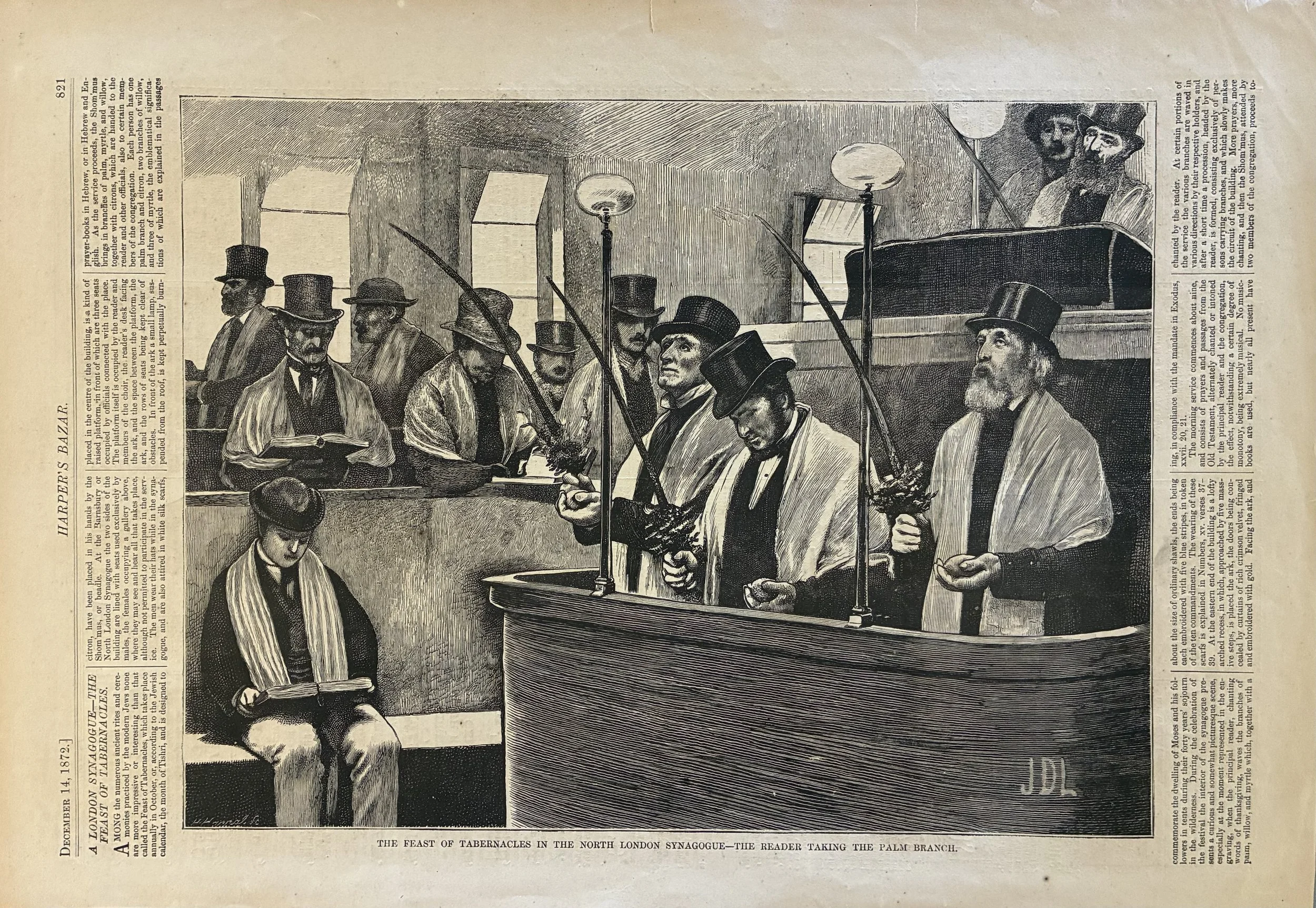
Object type: Illustrated newspaper engraving
Title: The Feast of Tabernacles in the North London Synagogue—The Reader Taking the Palm Branch
Date: December 14, 1872
Place of publication: London, United Kingdom
Publication: Harper’s Bazaar
Language: English
A LONDON SYNAGOGUE—THE FEAST OF TABERNACLES.
AMONG the numerous ancient rites and ceremonies practiced by the modern Jews none are more impressive or interesting than that called the Feast of Tabernacles, which takes place annually in October, or, according to the Jewish calendar, the month of Tishri, and is designed to commemorate the dwelling of Moses and his followers in tents during their forty years' sojourn in the wilderness. During the celebration of the festival the interior of the synagogue presents a curious and somewhat picturesque scene, especially at the moment represented in the engraving, when the principal reader, chanting words of thanksgiving, waves the branches of palm, willow, and myrtle which, together with a citron, have been placed in his hands by the Shom'mus, or beadle. At the Barnsbury or North London Synagogue the two sides of the building are lined with seats used exclusively by males, the females occupying a gallery above, where they may see and hear all that takes place, although not permitted to participate in the service. The men wear their hats while in the synagogue, and are also attired in white silk scarfs, about the size of ordinary shawls, the ends being each embroidered with five blue stripes, in token of the ten commandments. The wearing of these scarfs is explained in Numbers, xv. verses 37–39. At the eastern end of the building is a lofty arched recess, in which, approached by five massive steps, is placed the ark, the doors being concealed by curtains of rich crimson velvet, fringed and embroidered with gold. Facing the ark, and placed in the centre of the building, is a kind of raised platform, in front of which are three seats occupied by officials connected with the place. The platform itself is occupied by the reader and members of the choir, the reader's desk facing the ark, and the space between the platform, the ark, and the rows of seats being kept clear of obstacles. In front of the ark a small lamp, suspended from the roof, is kept perpetually burning, in compliance with the mandate in Exodus, xxvii. 20, 21.